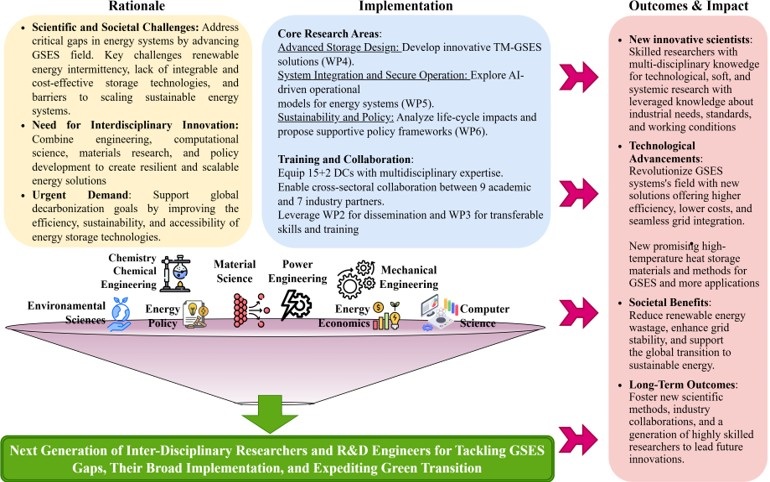
The aim of RESTORATIVE is to educate the future leading scientists and innovators within grid-scale energy storage, thereby providing the scientific, technological, environmental, and socioeconomic foundations required for accelerating the green energy transition.
All the key partners needed to address the challenges associated with large-scale energy storage systems and provide our group of 17 doctoral candidates with the best foundation for solving these challenges are included in the consortium. The network brings together leading European universities, research institutions, industrial partners, technology developers, engineering companies, and policy experts, creating a unique interdisciplinary and intersectoral research environment.
RESTORATIVE will provide first-of-its-kind excellent training for the doctoral candidates within the following fields:
• Innovative thermo-mechanical grid-scale energy storage technologies, including compressed air energy storage (CAES), liquid air energy storage (LAES), Carnot batteries, and advanced thermal energy storage systems.
• Cutting-edge multidisciplinary training in system modelling, optimization, artificial intelligence, machine learning, digitalization, operational planning, reliability assessment, resilience enhancement, and cybersecurity of future energy storage infrastructures.
• Advanced materials and thermal energy storage concepts to improve efficiency, durability, affordability, and sustainability of next-generation energy storage technologies.
• Environmental, economic, and societal assessment methods, including life cycle assessment, techno-economic analysis, energy policy, market design, supply chain analysis, and social acceptance of emerging energy technologies.
• Top-level training in transferable skills, including research and data management, scientific integrity and ethics, intellectual property rights, entrepreneurship, communication and dissemination, project management, leadership, career development, and grant proposal writing.
The project runs from 2026 to 2029 and will equip a new generation of highly skilled researchers with the interdisciplinary expertise required to develop, integrate, and deploy innovative grid-scale energy storage solutions that support a resilient, secure, and sustainable energy future.