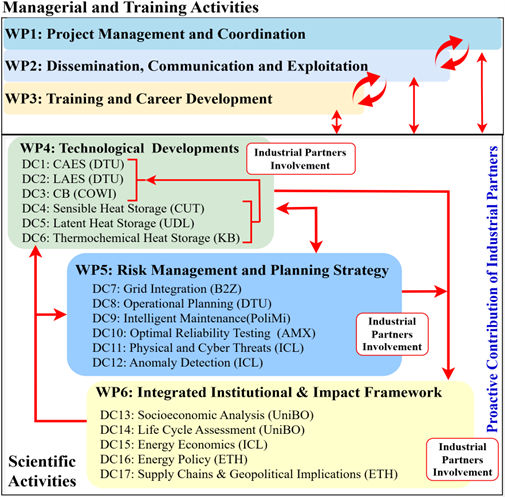
Description:
WP1 ensures the efficient management, coordination, and administration of the RESTORATIVE project. It oversees scientific progress, financial management, reporting activities, risk management, communication among partners, and compliance with Horizon Europe and MSCA requirements. The objective is to guarantee the successful implementation of the project and achievement of its scientific, training, and innovation goals.
Leader:
Technical University of Denmark (DTU), Denmark.
Description:
WP2 focuses on maximizing the visibility, impact, and long-term value of RESTORATIVE. Activities include dissemination of scientific results, communication with stakeholders and the general public, management of intellectual property, preparation of exploitation strategies, and promotion of collaboration between academia, industry, policymakers, and society.
Leader:
University of Bologna (UniBo), Italy.
Description:
WP3 delivers the interdisciplinary training programme for the 17 Doctoral Candidates. The work package combines scientific education with transferable skills training, including project management, entrepreneurship, communication, leadership, innovation, ethics, intellectual property rights, and career development. Through training schools, workshops, secondments, and industrial placements, the DCs will gain the skills required to become future leaders in academia and industry.
Leader:
University of Lleida8 (UDL), Spain.
Description:
WP4 develops the next generation of thermo-mechanical grid-scale energy storage technologies. The research focuses on innovative Compressed Air Energy Storage (CAES), Liquid Air Energy Storage (LAES), Carnot Batteries (CB), and advanced Thermal Energy Storage (TES) systems. The objective is to improve efficiency, reliability, flexibility, sustainability, and economic competitiveness while enabling large-scale renewable energy integration.
The six doctoral projects in WP4 address:
• Advanced CAES technologies• Industrial LAES systems
• Thermochemical Carnot Batteries
• Concrete-based thermal storage materials
• Phase-change thermal storage materials
• Metal-oxide thermochemical storage systems
Leader:
Technical University of Denmark (DTU), Denmark.
Description:
WP5 develops innovative methodologies for the secure, reliable, and optimal operation of grid-scale energy storage systems. It combines artificial intelligence, machine learning, digitalization, reliability engineering, cybersecurity, and operational planning to support safe and resilient future energy infrastructures.
The six doctoral projects in WP5 address:
• Grid integration of energy storage systems
• AI-assisted operation planning
• Predictive maintenance and digital twins
• Reliability and resilience optimization
• Cybersecurity of energy storage infrastructures
• Physics-aware anomaly detection systems
Leader:
Politecnico di Milano (PoliMi), Italy.
Description:
WP6 investigates the environmental, societal, economic, regulatory, and policy dimensions of future energy storage technologies. The goal is to establish sustainable pathways for large-scale deployment while ensuring social acceptance, environmental responsibility, economic viability, and policy readiness.
The five doctoral projects in WP6 address:
• Sustainability assessment
• Life-cycle assessment (LCA)
• Energy economics and market design
• Energy policy and innovation pathways
• Supply chains, industrial opportunities, and geopolitical implications
Leader:
Imperial College London (ICL), England.